Why Convert 1000 KJ to Calories?
It can be confusing when you see numbers on food labels in kilojoules (kJ) and you want to know what that means in calories. That’s why understanding 1000 KJ to Calories is so helpful. It feels like trying to understand two different languages when you just want to know what you’re eating. I often find myself trying to figure out these kJ numbers and turn them into something I understand, especially when looking at recipes or articles from other countries. It’s not just about the numbers; it’s about knowing the energy we put into our bodies.
Most of us grew up hearing about calories. It’s the unit we know best, and it’s been part of the talk about food and fitness for a long time. Even though Australia uses kilojoules on food labels, we still often think and talk about energy in terms of calories. That’s why knowing how to convert kJ to calories is so useful. It helps us compare foods, track how much we eat, and feel more in control of our diet.
Here’s why this conversion is helpful for me:
- Food Labels from Other Countries: When I travel or look at products from abroad, the energy might be listed in kJ. Knowing the conversion helps me compare it to foods here.
- Changing Recipes: Many recipes, especially online, list ingredients or total energy in calories. I need to change kJ to calories to know the meal’s energy.
- Fitness Trackers: My fitness watch shows energy burned in kJ, but I think better in calories. Converting helps me understand my workout.
- Easier Understanding: It just makes things clearer. Seeing 1000 kJ and knowing it’s about 240 calories feels more real than just a kJ number I don’t easily understand.
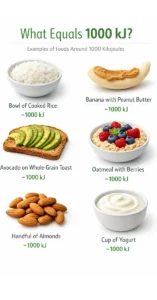
It’s not always about being super exact, but knowing the conversion, especially for a common amount like 1000 kJ, really helps me make better food choices and understand energy needs. It’s about making the information useful for me.
The main reason this conversion is popular is that most people are more used to calories. While Australia uses kilojoules on food labels, many other countries and online resources use calories. This makes it hard to compare things without knowing how to switch between the two. It’s just easier to think in the terms you know.
Honestly, it feels like a small trick to be able to look at a food label and quickly understand its energy content, no matter the unit. It takes a little practice, but once you get it, it makes things much simpler.
How to Convert 1000 KJ to Calories
Let’s get to the point of changing kilojoules (kJ) to calories. It’s not as hard as it sounds. Most of us know calories better, especially when looking at food labels or figuring out energy burned at the gym. So, how do we switch from kJ to calories?
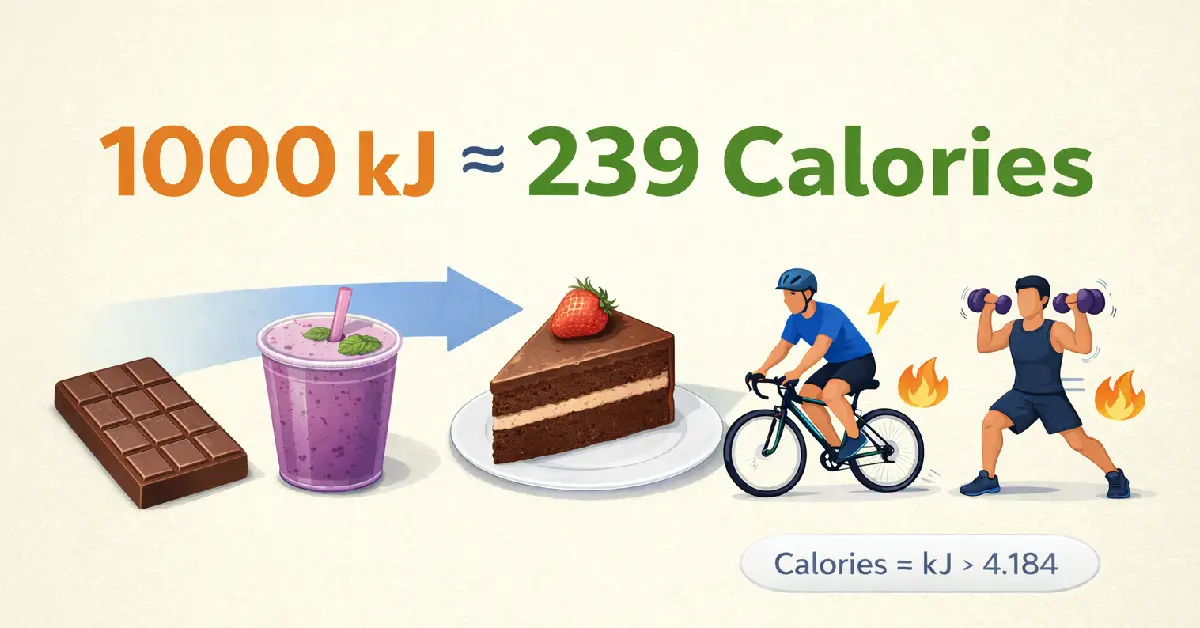
The basic way to convert is that 1 kilocalorie (which is usually what people mean by ‘calorie’) is about 4.18 kilojoules. To change kilojoules to calories, you divide the number of kilojoules by 4.18. For 1000 kJ, you do 1000 kJ divided by 4.18. This gives you about 239 calories.
Here’s a quick guide:
- The Key Number: The exact conversion is 1 kcal = 4.184 kJ. To go from kJ to kcal, divide by 4.184.
- An Easier Way: For a quick idea, you can often divide by 4. It’s not exact, but it’s fast for quick math.
- Going the Other Way: If you need to change calories to kilojoules (like for 1000 Calories to KJ), you multiply by 4.184.
So, 1000 kJ is roughly 239 calories. This is useful to know when you see different food labels or fitness tracker results. Understanding this simple conversion helps make sense of the energy numbers you see everywhere. For example, if you look at a food list, you might see energy in kJ, and knowing how to change it makes comparing foods much easier.
It’s important to remember that the energy numbers on food labels or from exercise machines are just guesses. They don’t consider all the ways our bodies use food or energy differently. So, while the conversion is helpful, it’s not perfectly exact for everyone.
If you want to know about specific foods, there are many places that can help you with the 1000 kJ to Calories conversion and more. It really makes tracking your food and exercise less confusing.
Conversion Table:
| Kilojoules (kJ) | Calories (kcal) |
|---|---|
| 1000 | 239 |
| 1100 | 263 |
| 1200 | 287 |
| 1300 | 311 |
| 1400 | 335 |
| 1500 | 358 |
| 1600 | 382 |
| 1700 | 406 |
| 1800 | 430 |
| 1900 | 454 |
1000 KJ: Real Food Examples
Seeing numbers like 1000 kilojoules (kJ) on a food label is one thing, but picturing what that looks like on my plate is another. I often look at the packaging and try to understand it. For me, knowing the energy in food is much easier when I can connect it to foods I actually eat.
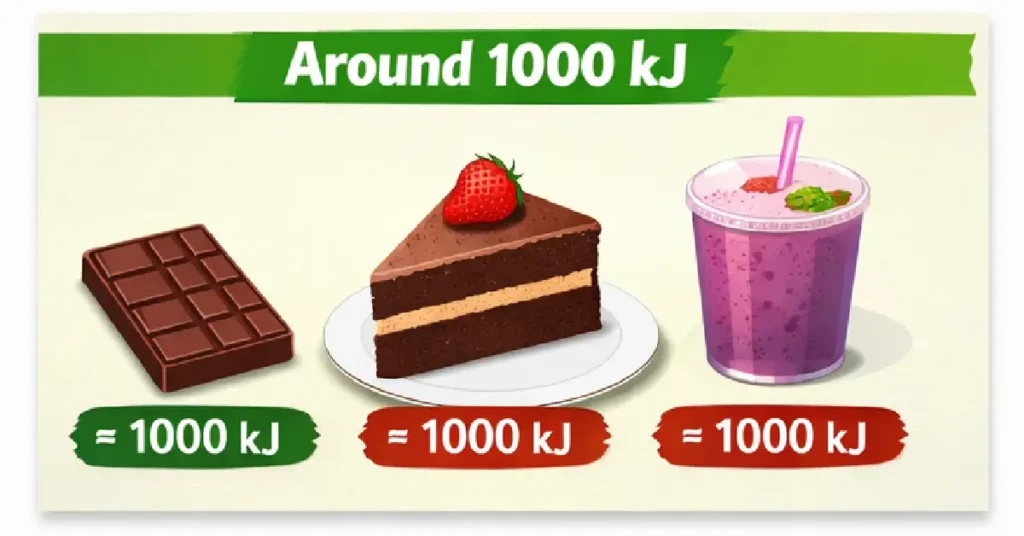
When I try to understand 1000 kJ, I think about common snacks. For example, a typical chocolate bar is often around this amount. It’s a quick way to imagine that energy amount. It’s not just sweets, though. Think about a small meal or a filling snack. A couple of crackers with some cheese might be around 700–900 kJ, so 1000 kJ could be a slightly bigger portion or a bit more cheese.
Here’s a rough idea of what 1000 kJ might look like in everyday foods:
- Chocolate bar: A typical small bar ≈ 1000 kJ
- Slice of cake: Many average around 1000 kJ
- Smoothie: A smaller or lighter smoothie ≈ 1000 kJ
- Snack combo: A few crackers with cheese or a small serving of fried rice
It’s also good to remember that food energy comes from different sources. Carbs, proteins, and fats all give energy. For example, fat has more than twice the energy per gram compared to carbs or protein. So, a food higher in fat will have more kilojoules for the same weight.
Knowing these real-world examples helps me make better choices when I’m out, especially when I’m trying to manage my energy intake without always using a calculator. It’s about building a mental picture of food energy.
When I look at food labels, I try to remember that 1000 kJ is about 240 calories (kcal). This conversion is useful because many online recipes and international nutrition info still use calories. So, if a recipe calls for 240 calories, I know that’s about the same energy as 1000 kJ. It makes comparing food energy much simpler.
Burning 1000 KJ in One Workout
So, you’ve used 1000 kilojoules (KJ) during a workout. That sounds like a good effort, right? But what does that mean for your body in terms of calories burned? It’s not a simple switch, unfortunately. Think about it: your body isn’t a perfect machine. When you exercise, a lot of the energy your body uses just becomes heat or keeps your basic body functions going. Only some of that energy goes into the work you’re doing, like riding a bike or lifting weights.
Generally, for every kilojoule of physical work you do, your body burns a bit more than that in actual calories. A common guess is that about 1 kilojoule of work is roughly equal to burning 1.1 calories (or kilocalories, which is what food labels usually mean by ‘Calories’). So, for 1000 KJ, we’re looking at around 1100 calories burned. This is a helpful general number, but remember it can change.
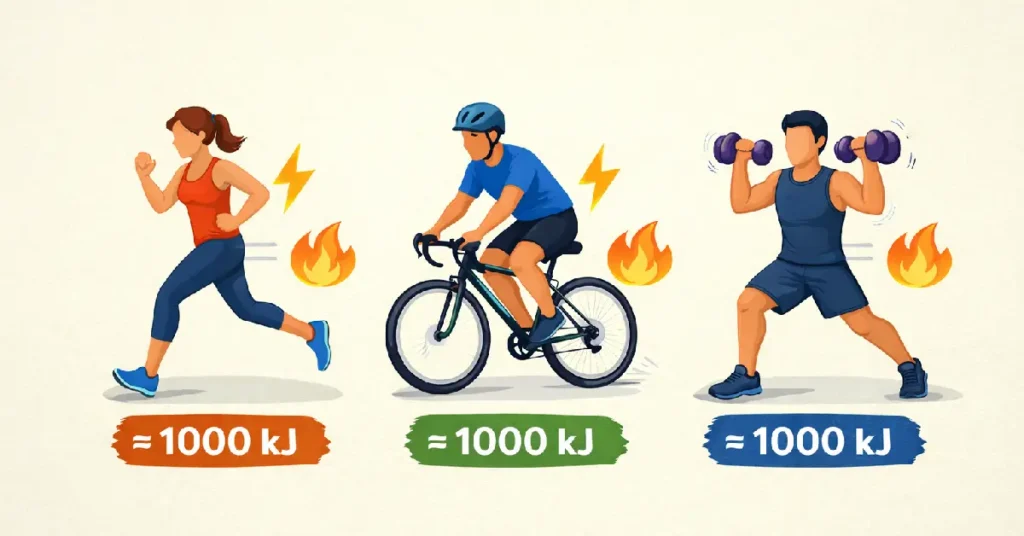
Here’s a rough idea of how different activities might compare to burning 1000 KJ:
- Cycling: 30–40 minutes at moderate effort
- Running: 25–30 minutes at steady pace
- Strength training: 45 minutes with minimal rest
It’s important to remember that these are just guesses. Things like your fitness level, how hot it is, and even how you move (your body’s mechanics) can all affect how well your body uses energy. So, while 1000 KJ is a good marker, the actual calories burned might be a bit more or less.
The energy measured by devices like power meters often shows the physical work done. Your body, however, uses more energy than this to produce that work, with a lot lost as heat. Therefore, the calorie count you see is an estimate of your body’s total energy use, not just the work output itself.
So, next time you see that 1000 KJ number, you’ll have a better idea of what it means for your calorie budget. It’s a solid workout, and now you know roughly how many calories you’ve used towards your fitness goals.
Track Your Energy Smarter
I’ve been trying to understand my energy intake and use, and honestly, it’s sometimes confusing. You see the numbers on food labels, usually in kilojoules (kJ) here in Australia, and then you hear about calories (kcal) from workouts or general advice. It’s easy to get lost.
I’ve found that tracking my energy, especially when I’m aiming for a goal like 1000 kJ, is much easier when I have a plan. It’s not just about the numbers, but understanding what they mean for my body and my goals.
Here’s how I’ve started to figure it out:
- Know the basic change: The simplest way to think about it is that 1 kilojoule is about 0.24 kilocalories. So, 1000 kJ is about 240 kcal. Simple, right? But that’s just the start.
- Think about your body’s effort: This is where it gets interesting. When I do a workout, say on my bike, the energy my device shows (in kJ) isn’t the total energy my body burned. My body isn’t a perfect machine; a lot of energy is lost as heat. For cycling, I’ve read that we’re only about 18-24% efficient. So, to actually do 1000 kJ of work, my body might have to burn closer to 1000 kJ / 0.22 (assuming 22% efficiency), which is around 4545 kJ, or about 1086 kcal. That’s a big difference!
- Use tools, but know their limits: Fitness trackers and bike computers are great for giving me information. They often show kJ burned. But I’ve learned to not take those numbers as exact. They usually measure the physical work done, not the total energy your body used. For a clearer picture, I try to include that efficiency percentage.
It’s not just about the number on the scale or the workout summary. It’s about understanding the energy moving inside me. When I see 1000 kJ on my bike computer, I now know my body likely worked much harder than that number shows to do it.
I’ve also started looking at food labels more closely. They usually show kJ, and sometimes kcal too. It helps me see how much energy I’m eating compared to what I’m using. For example, if I know I burned about 1000 kcal in a workout, and I’m looking at a snack that’s 500 kJ (about 120 kcal), I can see that’s a good part of what I used. It’s all about becoming more aware.
Frequently Asked Questions
How to estimate calories quickly from kJ?
Divide the kJ number by 4 for a quick estimate. For exact numbers, divide by 4.184.
How do I easily change 1000 kilojoules to calories?
To change kilojoules into calories, you just divide the kilojoule amount by 4.18. So, for 1000 kilojoules, I’d do 1000 divided by 4.18, which gives me about 239 calories.
Which common snacks are around 1000 kJ?
Small chocolate bars, a slice of cake, or a light smoothie are often close to 1000 kJ.
Why are kilojoules used instead of calories in Australia?
Australia uses kJ on labels as the standard unit, while calories are more common in international recipes and fitness advice.
Does 1000 kJ mean the same for everyone’s energy needs?
Not exactly — energy use varies with fitness, body size, and activity efficiency.