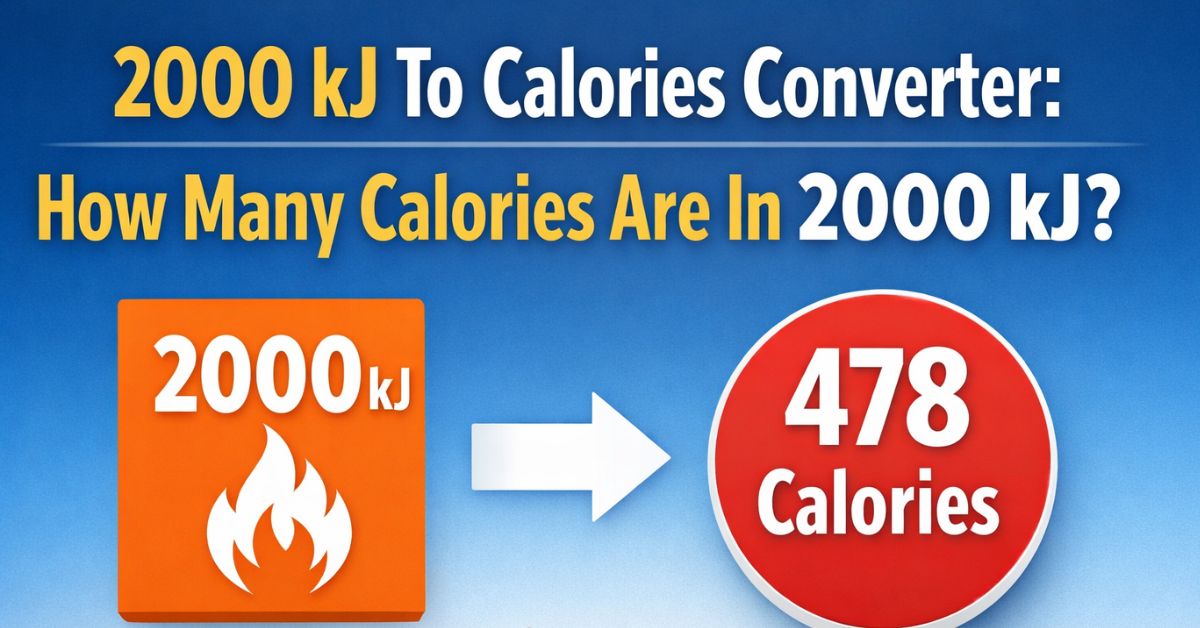
Energy on food labels is often shown in kilojoules (kJ), while many people track energy in Calories (kcal). If you’re wondering how many Calories are in 2000 kJ, the answer comes directly from a fixed scientific conversion.
Quick Answer: 2000 kJ to Calories
2000 kJ = 478.01 Calories
Most nutrition labels round this to:
≈ 478 Calories
Conversion Formula for kJ to Calories
The standard conversion used worldwide is:
- 1 kilojoule (kJ) = 0.239005736 Calories (kcal)
So:
Calories (kcal) = kJ × 0.239005736
Now apply it to 2000 kJ:
2000 × 0.239005736 = 477.97 kcal
So 2000 kJ is just under 500 Calories.
2000 kJ converted to Different Energy Units
| Energy unit | Value |
| Kilojoules (kJ) | 2000 kJ |
| Calories (kcal) | 477.97 kcal |
| Small calories (cal) | 477,970 cal |
| Kilowatt-hours (kWh) | 0.555 kWh |
| Joules (J) | 2,000,000 J |
Note: kcal = food Calories.
When you see Calories on labels, it actually means kilocalories.
2000 kJ in Calories for common foods
Here’s what ~2000 kJ (≈ 478 Calories) is roughly equal to in food portions:
| Food item | Approx amount equal to 2000 kJ |
| Slice of pizza | 1.5–2 slices |
| Chocolate bar | 1 medium bar |
| Eggs | 6–7 large eggs |
| Cooked rice | ~2 cups |
| Avocado | 1.5 avocados |
| Banana | 4–5 bananas |
| Chicken breast | ~200–230 g cooked |
| Fries | Medium fast-food fries |
These values are averages; exact values vary by brand and preparation.

How 2000 kJ Fits Into Daily Energy Needs
Your daily energy needs depend on age, sex, height, weight, and activity level.
Typical daily intake ranges:
| Group | Approx daily need |
| Average adult woman | 7,500–8,700 kJ (1800–2100 kcal) |
| Average adult man | 9,200–10,500 kJ (2200–2500 kcal) |
| Weight loss ranges | 5,800–8,400 kJ (1400–2000 kcal) |
| Athletes | 10,500–16,800 kJ (2500–4000 kcal) |
So 2000 kJ usually represents:
- about 20–30% of daily intake for most adults
- a small meal + snack, or
- one large fast-food meal
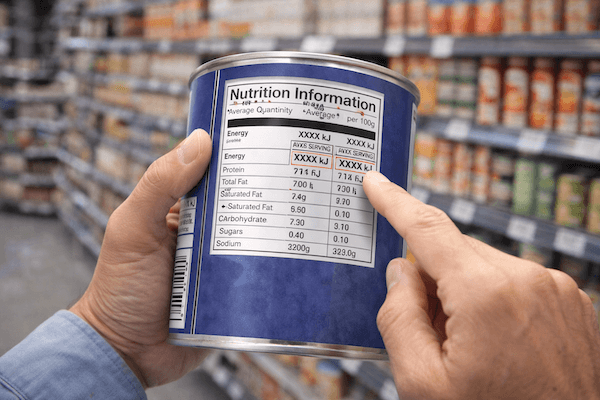
Why Some Labels Use kJ and Others Use Calories
- kJ is the SI scientific unit
- Calories (kcal) are more familiar in the U.S. and many countries
- Australia, the EU, and NZ use kJ primarily on labels
- Many labels show both (kJ first, kcal in brackets)
kJ vs Calories – What’s the Difference?
They measure the same thing: energy.
The only difference is the unit.
- kJ = metric scientific unit
- kcal / Calories = common nutrition unit
Just like:
- kilometers vs miles
- kilograms vs pounds
Energy is the same – only the label changes.
Frequently Asked Questions
How many kJ are in 2000 calories?
There are 4.184 kJ in 1 calorie (kcal), so 2000 calories equals 8,368 kJ. This is close to the commonly recommended daily energy intake for an average adult, though needs vary by person.
How to burn 2000 kJ a day?
Since 2000 kJ is about 478 calories, it can typically be burned through activities like brisk walking for about an hour, cycling for 45–60 minutes, jogging for 30–35 minutes, or a mix of everyday movement and light exercise. The exact amount varies based on body weight and workout intensity.
Can I lose weight on 2000 calories a day?
You can lose weight on 2000 calories per day if your maintenance calories are higher than 2000. If your body requires around 2000 calories, your weight will stay stable; if it needs less, you may gain. Weight change depends on age, sex, height, muscle mass, and activity level.
What is the minimum calories per day to survive?
The minimum energy needed for basic body functions is your Basal Metabolic Rate (BMR), which for most adults falls around 1200–1600 calories per day. Regularly eating far below this may cause fatigue, nutrient deficiencies, and muscle loss and should only be done under medical supervision.
What is the 3-3-3 rule for weight loss?
The 3-3-3 rule usually means three meals a day, no snacks between, and no food three hours before bed, with some versions adding a daily 3-mile walk. It’s a simple behavioral framework rather than a strict scientific rule, helping many people reduce snacking and create a calorie deficit.